Bots, notaries, and Robert Langdon.
Bots, notarised raffles, puzzles, and the collective work behind Tío Drops. How Drops earned the right to sell out.

Empty spaces in communication always get filled by someone. For years I didn't tell this story, so other people told it.
Here's mine.
I remember a pair of Jordan 1s. It was the pandemic. Something went wrong during the launch and I had to cancel orders from people who hadn't followed the rules. The terms were explicit: one pair per person.
My personal Instagram exploded with insults and threats. That's when I thought: wow, shit got serious.
I had to set my account to private. I leaned on my team, especially Maida Cox and Néstor Díaz, who took over running the launches from then on.
Bots, notaries, and somebody's grandmother
During the pandemic, a lot of resellers — following the "Supreme flipper" playbook — started programming bots to buy up as many pairs as they could from the most exclusive releases and flip them afterwards. Fair enough. We weren't trying to end resale; we were trying to find a way of selling that rewarded merit and a real love of sneaker culture.
Before we got to the scavenger hunts, we tried notarised raffles to make access fairer. In practice they were enormously cumbersome and expensive, because you had to pay the notary for every single draw. They weren't even that clean: resellers would send their grandmother to sign up. We wanted to democratise access and we ended up financing notaries.
Then there was the technical problem. Every launch, the bots could take the site down, so we had to hire Queue-it, a virtual queueing provider, to stop that happening. Sneaker glory has a fairly concrete limit: the site staying up.
We had to do something better. Something cooler.
Robert Langdon at a sneaker launch
I'm a fan of the Robert Langdon books. I wanted the hunt to feel like that: anagrams, riddles, mental tests. Adrenaline and pure cognitive puzzles. That's where the idea of building scavenger hunts around the launches came from. Dan Brown probably didn't write them with a sneaker launch in Chile in mind, but it worked.
I mentioned the idea to Cata Soffia and Maida Cox. They took off with it immediately and then knocked it out of the park.
It also gave us another point of contact with the customer. It wasn't only the transaction any more; we were getting in a bit deeper. Drops wanted to become a kind of governing body. The validator. The authority.
The first scavenger hunts were Nike Re-Stock and, after that, Bad Bunny x adidas.
The stock was there, you just had to find it
Nike Re-Stock wasn't the launch of a specific SKU. During the pandemic, with the stores closed and everything running through e-commerce, some pairs simply didn't sell and gradually piled up. The same thing happened to us with Yeezy.
The problem was how to put them back on sale. We'd been communicating sold-outs, and a sold-out that reappears out of nowhere is, to put it elegantly, odd. We had to solve it without pretending nothing had happened. That's why these first mechanics were more underground, more cryptic: the stock was there, but you had to find it.
swipe to see the full slide →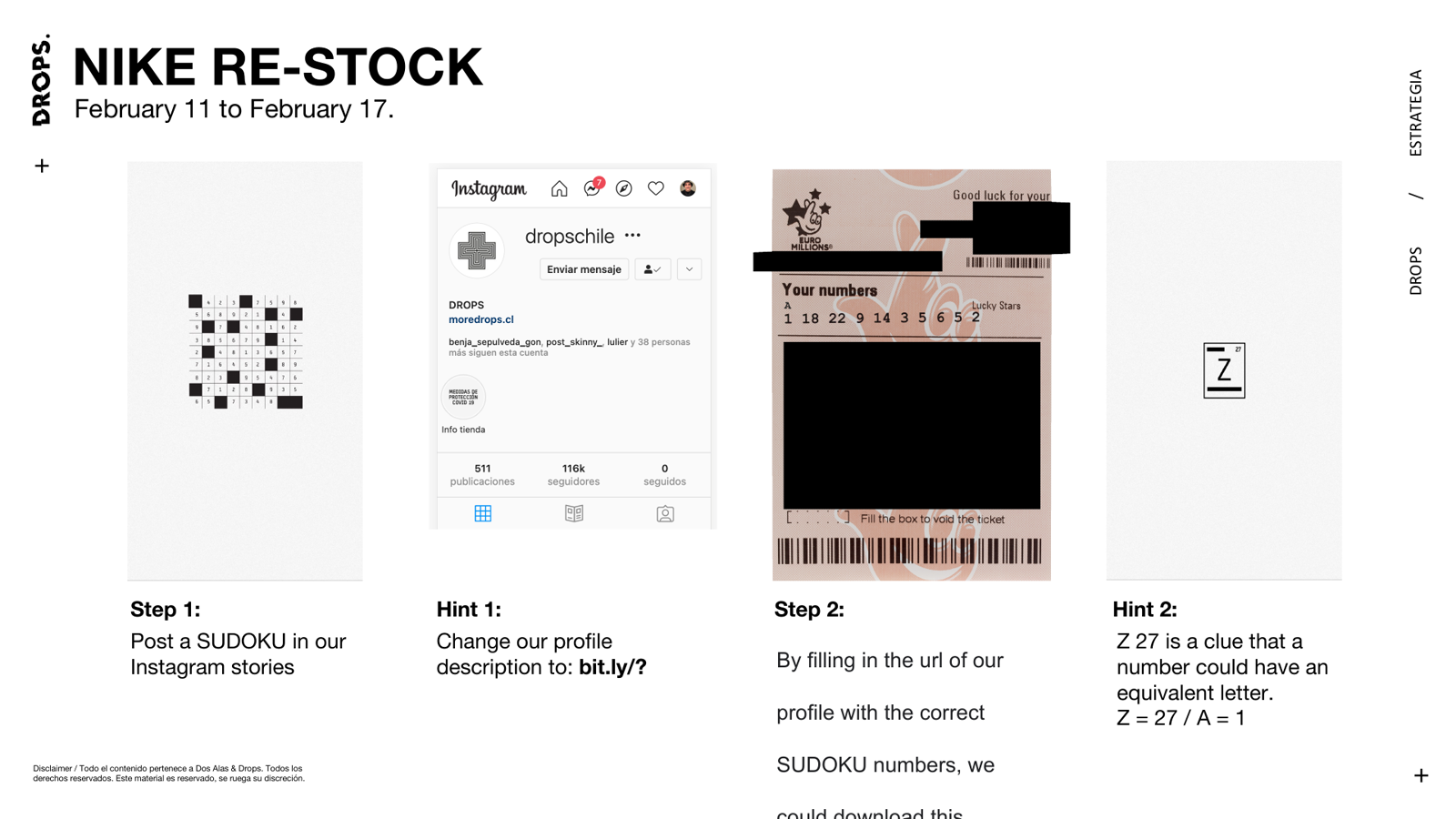
For the Nike one, the challenge started with a Sudoku posted in stories. Solving it produced the numbers that completed a URL; then you had to turn numbers into letters to find the sale date: the fifteenth of February, 2021.
In March came Bad Bunny x adidas. This time solving the clues didn't just reveal a date: it gave you a better shot at the launch itself. The game started publicly and continued over direct messages. One clue led to the next: CHAMPION, DRIVER, CAFÉ, BAD BUNNY FORUM. Two hundred and thirty-five people solved the first stages, 132 advanced, and 45 made it to the end.
swipe to see the full slide →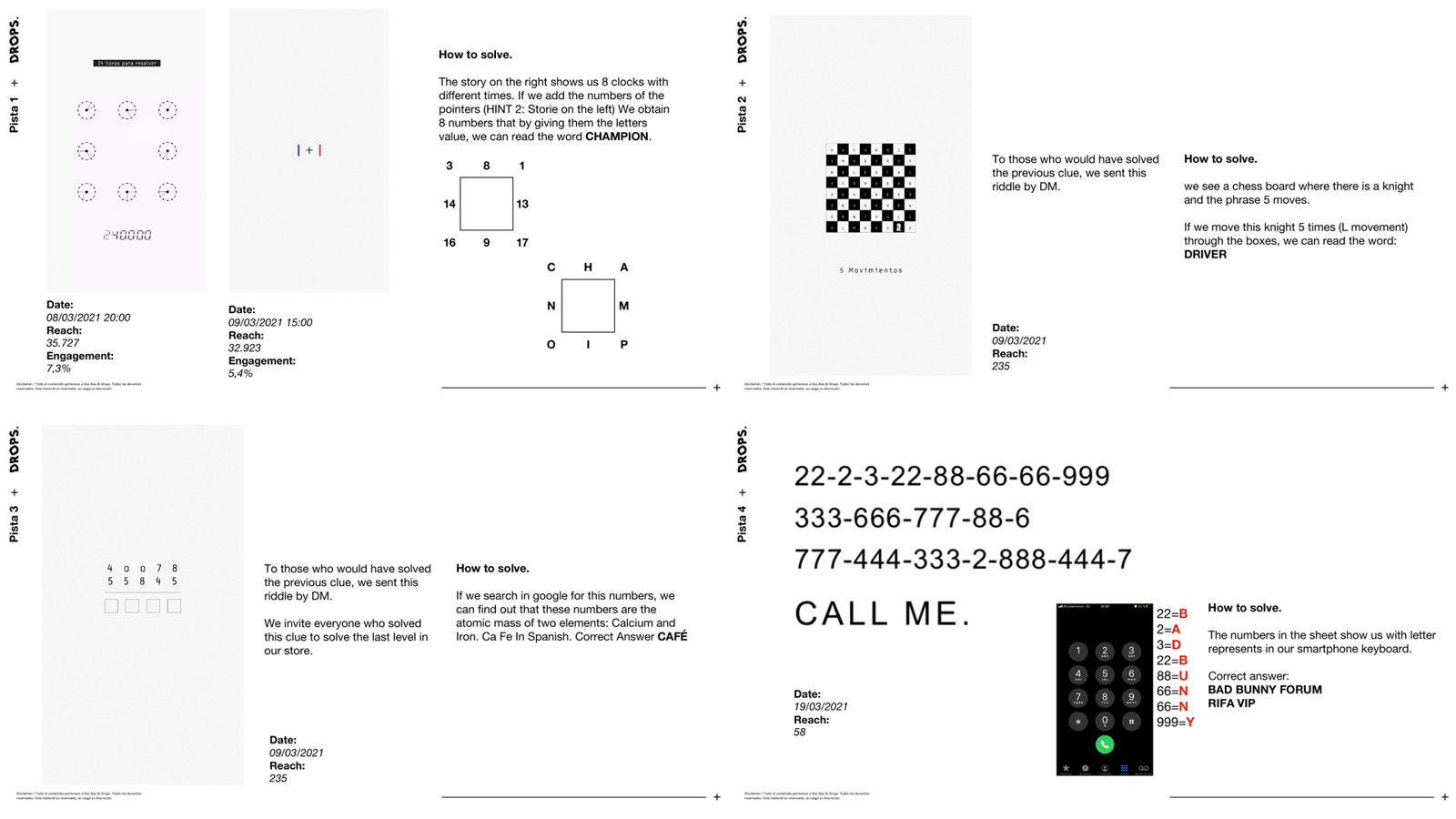
In June we ran an even bigger challenge. It started with an augmented reality filter and a QR code. Then came public riddles, clues by direct message and, at the end, a file with 270,000 possible combinations. A completely reasonable measure, obviously. Four thousand seven hundred and fifty-nine people scanned the QR; 101 completed the whole route and got access to the special sale.
What the community did
But what I liked most wasn't the numbers. It was following the people taking part, watching them try to crack the clues, and the memes they made.
Telegram, WhatsApp and Facebook groups appeared. People compared theories, translated words and shared tips. The screenshots are still in that campaign's recap: someone wrote "me dejai loco Drops 💎"; someone else asked us to "hagan más cositas así."
They also made memes, because they thought the puzzle was too hard. One showed a guy with a swollen, giant brain. The caption read:
EL CONCHETUMARE QUE SE SABE EL ACERTIJO DE DROPS.

That confirmed to me that we had something to offer the global sneakerhead scene. We had nothing left to envy in the stores we'd idolised for so long.
It was never just one person
It was a joint effort. On our side it was Maida Cox, then Marketing manager; Catalina Soffia, Creative and Branding director; and me. Diego Iturriaga, head of Design, worked on the 3D animations. Néstor ran e-commerce: he published the products at the exact hour and made sure the site held up during launches.
At that point Dos Alas managed the account, and Matías Pinto was the lead on the agency side. We wrote the copy collaboratively; they uploaded the content and did the community management.
It was ideas and a lot of hallway conversations, deeply collaborative work where everyone put something in. It was never just one person.
Over time the teams and the roles changed. Different people wrote, designed, answered comments and ran the account's everyday voice. The relationship with the agencies changed too. At one point we decided to bring community management in-house, to make the cost more efficient and because we felt Dos Alas had stopped innovating with the account.
Whoever ran the account had to understand that this isn't transactional. There's a community of sneakerheads behind the screen for whom our brand carries a particular weight, and that responsibility can't be taken lightly. We also have a responsibility to keep getting better every day, because what was cool last year probably isn't cool now.
The name wasn't something we came up with internally. When the community asked about launch details, they started calling the account el Tío Drops. The same thing had happened earlier with Tío Bold.
I don't remember the precise moment it appeared. It came from the community and moved naturally from one brand to the other.
In 2021 we won, together with Dos Alas, first place at the Premios Eikon Chile, in the General Digital Campaign category. The case was called "Drops: y cómo cambiar la relación con tu audiencia." So we weren't the only ones who thought there was something there.
Several people who worked with us were invited onto interviews and podcasts, and told their version. I got all of it: people I'm very fond of who portrayed what we built really well, and also some who claimed more than was theirs.
And I won't lie to you: it made me angry. That's why I'm writing this.
When the story gets told only from the result, you lose all those conversations where we dreamed together about what we'd have to do to get level with the stores we looked up to. Kith, Supreme, Solebox: relatively small shops, but with enormous cultural weight. You could see it in their collaborations with the brands I admire: Nike, Jordan, adidas.
And you also lose how everyone contributed their piece to get to the result we eventually saw.
How you get to a Jordan 3 Balvin
Because you climb. To get access to the most exclusive product you have to prove you can build community, that the branding is consistent, that the store is world-class and that the product curation is right. And above all, you have to keep showing you're capable of the coveted sold-out.
A famously exclusive pair that doesn't sell somewhere signals weak traction. No storytelling fixes that. The mere fact of getting access to a model like the Jordan 3 Balvin meant we'd been doing the work well and consistently for years.
A campaign like that involves a lot of people and a lot of areas. Not only from Yáneken — from Nike Chile too. Everyone contributes.
That story started before Drops. Our first Quickstrike — QS, in sneaker slang — was the Air Max Zero. Then we relaunched Jordan in Chile. Later came the first campout, for a pair of Vans x Fear of God. All of that was at Bold, before Drops even existed.
Today I still run the whole strategy for Drops. The last big decision was moving the store to the MUT and completely changing its look and feel. But that story, like the creation of Drops, deserves its own piece.
Over all these years there were many people behind Drops. Some wrote, others designed, built puzzles, hid boxes, answered comments or ran launches. Each one left something of their own. That's how brands get built.
Long before that, exclusive pairs arrived in Chile inside a suitcase, bought on a trip or ordered from abroad. Around then I started asking myself a question: why shouldn't we be the ones capable of bringing the pinnacle of fashion here, to Chile?
Then came Bold, the first QSs, the return of Jordan, the campouts, Drops, Ahumada, the puzzles and the MUT.
The teams kept changing. The question stayed.
- Bad Bunny x adidas
- marzo 2021
- Resolvieron las primeras etapas
- 235
- Avanzaron
- 132
- Llegaron al final
- 45
- Desafío Q2 · QR escaneados
- 4.759
- Completaron el recorrido
- 101
- Premios Eikon Chile 2021
- Primer puesto · Campaña General Digital
A note on the award. Premios Eikon Chile 2021, First place, General Digital Campaign — Web, Social Media and Mobile Digital Communication. The recognition went to Drops – Dos Alas Digital, for the campaign “Drops: y cómo cambiar la relación con tu audiencia.” Source: Premios Eikon Chile, official winners document.
- The Retail Brief · 9 min · essay
K-pop, anime, and a mall where we'd already failed.
The first Bold we opened in Los Dominicos failed. On Saturday we open there again — this time having read what the mall had turned into.
- The Retail Brief · 8 min · essay
How we deploy AI across a large retail store network.
No app to install, no training, no six-month project. What we learned putting AI to work across 160+ stores over WhatsApp.